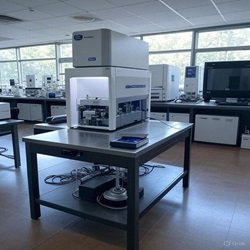
Gas Chromatography With Flame Lonization Detection (GCFID) /Electron Capture Detection (ECD)
Allschoolabs · 21 day(s) estimated delivery
₦15,000
Description
Gas Chromatography with Flame Ionization Detection (GC-FID) and Electron Capture Detection (GC-ECD): Principle and Applications
Gas Chromatography (GC) combined with Flame Ionization Detection (FID) and Electron Capture Detection (ECD) are widely used analytical techniques for separation, identification, and quantification of volatile and semi-volatile compounds in complex mixtures. These detectors offer complementary capabilities, making them essential in environmental monitoring, pharmaceuticals, food safety, and petrochemical analysis.
Flame Ionization Detection (FID)
Principle: Organic compounds are ionized in a hydrogen-air flame; resulting ions produce an electrical current proportional to carbon content.
Key Features:
Highly sensitive to hydrocarbons and organic compounds.
Broad linear response range.
Not sensitive to inorganic gases (e.g., CO₂, H₂O).
Applications: Petroleum analysis, flavor and fragrance profiling, residual solvent testing in pharmaceuticals.
Electron Capture Detection (ECD)
Principle: Measures the reduction in current caused by electron-absorbing compounds (typically halogenated molecules) in a beta radiation field.
Key Features:
Extremely sensitive to halogens, nitriles, and organometallic compounds.
Low detection limits (picogram range).
Not suitable for non-electron-capturing compounds.
Applications: Pesticide residue analysis, polychlorinated biphenyls (PCBs), and chlorinated solvent detection in environmental samples.
Importance in Analytical Science
By pairing GC-FID and GC-ECD, laboratories can achieve comprehensive profiling of both general organics and halogenated pollutants, ensuring accurate quality control, safety testing, and regulatory compliance across industries.
2g
21 Days
Both
Mon 3 - Fri 2
Packaging Instructions
For Liquid samples, per analysis, measure 5ml
Measure 2grams per analysis for solid samples
Liquid samples should be sent in sample bottles, pet bottles, or any air-tight container.
Solid samples should be sent in zip lock bags, sample bottles, or any air-tight container.
Samples should be labeled legibly with paper tape, marker, or writing pen.
Labels should be short and precise (not more than 3 words).
All samples must be strapped together and secured in a bag prior to transport.
Write the Following on the Bag, or Envelope “Allschoolabs Analysis – Receiver: Madison, 08163383206” then add the address of whichever collection center you are sending to.
Comments & Questions (0)
Quick Booking
Book this test, request pickup/drop-off, or ask the lab a question before payment.
Browse More Tests